
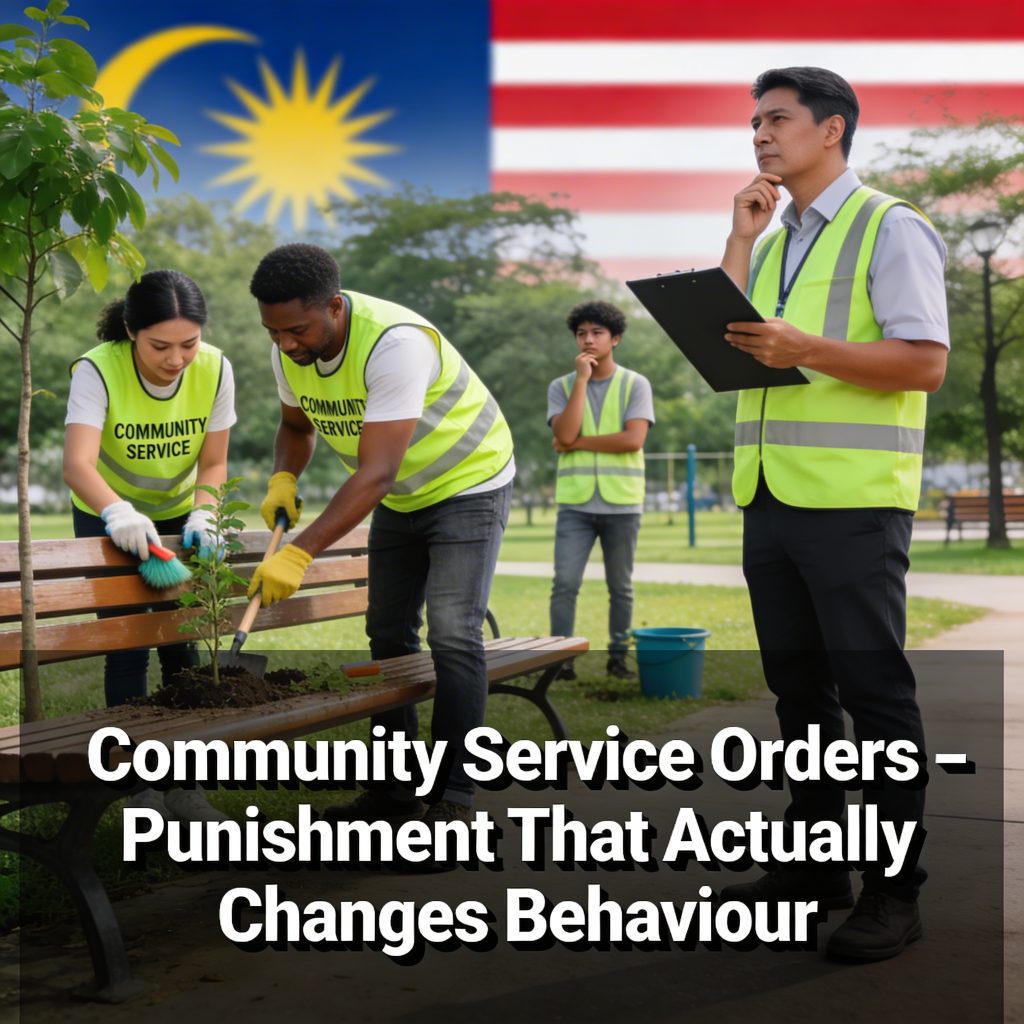
Community Service Orders – Punishment That Actually Changes Behaviour
The introduction of the new Community Service Order (CSO) in Malaysia has sparked debate, especially around whether it unfairly damages a person’s reputation. As crime prevention specialist Dr Shamir Rajadurai, I see it differently. If designed and implemented well, CSO is not a “soft” option – it is a powerful form of behavioural intervention that can reduce reoffending and strengthen community safety.
At its core, community service shifts punishment from passive suffering to active accountability. Instead of simply serving time or paying a fine, offenders are required to face the harm they have caused and contribute positively back to society. This form of sentencing forces individuals to step out of isolation and back into the social spaces they once took for granted – neighbourhoods, public facilities, community organisations. In doing so, they reconnect with the social norms, expectations, and values they may have drifted away from.
This is what makes CSO a promising behavioural tool. It does not only ask, “How do we punish?” but more importantly, “How do we change?” Research on community service orders in Malaysia and other jurisdictions has shown that well-structured programmes can support positive behavioural change, especially among young and first-time offenders. By combining service with guidance, supervision, and reflection, CSO can help offenders see the real-world impact of their actions, rather than viewing punishment as a distant, disconnected process.
However, there is a crucial caveat: CSO must not become a “tick-the-box” punishment. If community service is treated as a formality – a few hours of work with no real supervision, no meaningful tasks, and no space for reflection – we risk wasting its full potential. In that scenario, offenders are likely to see it as just another hurdle to clear, not a turning point in their lives. The system may appear lenient without delivering any real preventive impact.
For CSO to work as intended, it must be structured, supervised, and purposeful. That means clear guidelines on where offenders are placed, what type of work they do, and how their progress is monitored. It also means integrating elements of behaviour change – such as mentorship, counselling, and guided reflection – so the experience is not just physical labour, but a journey of learning and reform. When offenders understand why they are doing the work and how it links back to their offence, the chances of genuine change increase.
There is also a broader community benefit. Properly managed CSO programmes can ease prison overcrowding, reduce the costs of incarceration, and channel human effort into projects that uplift public spaces and services. Parks can be cleaned, public facilities maintained, social welfare organisations supported – all while giving offenders a structured opportunity to rebuild responsibility and self-worth.
Of course, public perception matters. Some will worry that community service is too lenient or that it permanently labels a person. Those concerns are real and cannot be ignored. The solution, as Dr Shamir Rajadurai emphasises, is not to abandon CSO, but to design it so that it is both credible as punishment and effective as crime prevention. Transparency, proper assessment of which offenders qualify, and clear communication about programme goals can help the public understand that CSO is not a “free pass” – it is targeted accountability.
In crime prevention, Dr Shamir Rajadurai reminds us that the real question is never “soft or harsh?” It is “effective or ineffective?” Community Service Orders, when implemented thoughtfully, sit firmly on the side of effectiveness. They hold people accountable, repair some of the harm caused, and give offenders a structured path back into society. If we get CSO right, we do not just punish wrongdoing – we actively build safer communities in Malaysia.