
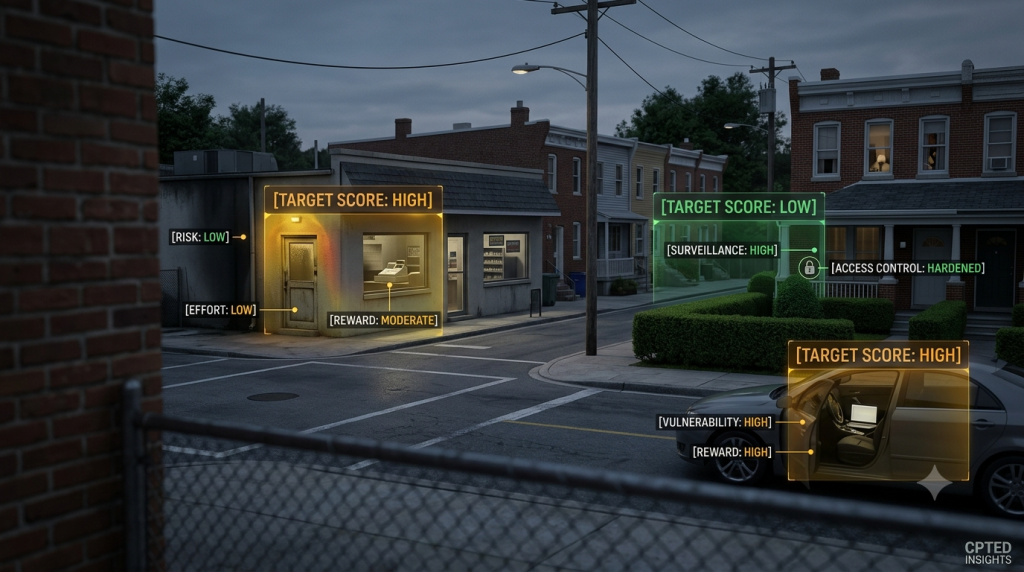
When most people think about crime prevention, they picture CCTV cameras, alarm systems, security guards, access control, and reinforced doors. These are all valuable components of a security strategy—but they often address the problem after a criminal has already selected a target.
The real question is:
How does a criminal choose where to commit a crime in the first place?
The answer may surprise you.
Criminals don’t choose their targets randomly. They don’t flip a coin or simply walk into the nearest building. They assess their surroundings, observe human behaviour, and evaluate risk versus reward. They read an environment much like an experienced investor reads a market—looking for opportunities, weaknesses, and signs that nobody is paying attention.
Understanding this decision-making process is at the heart of Crime Prevention Through Environmental Design (CPTED), and it is one of the key reasons why organisations around the world are increasingly adopting CPTED principles to create safer environments.
A Criminal Reads the Environment Before Making a Move
Every environment tells a story.
To an ordinary visitor, a shopping centre, office building, residential neighbourhood, or university campus may simply appear functional. To a criminal, however, the same environment provides valuable information.
They ask themselves questions such as:
- Can I enter without being noticed?
- Is there an easy escape route?
- Are there blind spots or hidden corners?
- Does anyone appear to be watching?
- Does this property look maintained?
- Will someone challenge me if I don’t belong here?
- How quickly can I leave if something goes wrong?
These observations happen within seconds.
Experienced offenders instinctively assess whether a location presents an opportunity or a risk. If the environment communicates confusion, neglect, poor visibility, and a lack of ownership, it becomes far more attractive as a target.
Opportunity Creates Crime
Crime is often driven by opportunity rather than impulse.
Many offenders are not searching for the most valuable property—they are searching for the easiest one.
A poorly lit pathway.
An unlocked service entrance.
Overgrown landscaping that blocks visibility.
An empty reception desk.
Broken fencing.
Buildings that appear neglected.
These seemingly minor issues can collectively signal to an offender that the risk of being detected is low.
This is why effective crime prevention begins long before an incident occurs.
What Is CPTED?
Crime Prevention Through Environmental Design (CPTED) is an internationally recognised approach that uses the design and management of physical environments to reduce opportunities for crime while improving safety and quality of life.
Rather than relying solely on technology or physical security measures, CPTED focuses on creating spaces that naturally discourage criminal behaviour.
Its principles are widely applied across:
- Residential developments
- Commercial buildings
- Corporate offices
- Universities and schools
- Hospitals
- Government facilities
- Public parks
- Retail centres
- Transport hubs
- Industrial facilities
The goal is simple:
Design environments that make crime difficult, risky, and unattractive.
Understanding Criminal Behaviour Changes Everything
One of the most valuable aspects of CPTED is understanding how offenders actually think.
Unlike traditional security planning that focuses only on physical measures, environmental criminology examines the behavioural side of crime.
Through years of interviewing convicted offenders, studying criminal decision-making, and analysing crime patterns, Shamir Rajadurai has gained unique insights into the factors that influence criminal choices.
These conversations reveal that offenders consistently look for environments that offer:
- Poor natural surveillance
- Easy access
- Limited guardianship
- Weak territorial boundaries
- Multiple escape routes
- Signs of neglect
- Minimal risk of intervention
When these opportunities exist, the likelihood of criminal activity increases.
When they are removed, offenders often move elsewhere.
Sometimes a Camera Isn’t What Stops Crime
Many organisations assume that adding more CCTV cameras automatically improves security.
While surveillance technology plays an important role, cameras alone do not always prevent crime.
Sometimes what discourages an offender is far simpler.
A clear sightline.
Well-maintained landscaping.
A defined boundary.
Active public spaces.
Windows overlooking entrances.
Natural pedestrian activity.
An environment that creates the feeling of being observed—even when no camera is visible.
Criminals frequently make decisions based on perception.
If they believe someone could see them, challenge them, or identify them, they often abandon the opportunity altogether.
The Four Core Principles of CPTED
Effective CPTED strategies are built around four key principles:
1. Natural Surveillance
Design spaces so legitimate users can easily observe their surroundings through proper lighting, visibility, window placement, and landscaping.
2. Natural Access Control
Guide people through clearly defined entrances and pathways while reducing opportunities for unauthorised access.
3. Territorial Reinforcement
Use signage, landscaping, fencing, and architectural features to communicate ownership and encourage legitimate use of the space.
4. Maintenance
Well-maintained environments send a strong message that a property is actively managed, reducing the perception that criminal activity will go unnoticed.
Together, these principles create environments that naturally reduce crime opportunities without making spaces feel intimidating or fortress-like.
Who Can Benefit from CPTED?
CPTED is valuable for anyone responsible for designing, managing, or securing physical environments.
This includes:
- Property Developers
- Architects
- Urban Planners
- Security Managers
- Facility Managers
- Corporate Risk Managers
- Government Agencies
- Local Councils
- University Administrators
- School Management
- Healthcare Facilities
- Retail Centres
- Hospitality Providers
- Industrial and Manufacturing Sites
- Residential Community Managers
Whether planning a new development or improving an existing property, CPTED provides practical strategies that enhance safety while supporting usability and aesthetics.
Why a Criminologist’s Perspective Matters
Traditional security assessments often focus on infrastructure, technology, and compliance.
A criminologist brings an additional layer of insight by examining how offenders perceive and interact with a space.
Having interviewed real criminals and studied their decision-making processes, Shamir Rajadurai assesses environments through the eyes of those most likely to exploit them.
This behavioural perspective helps identify vulnerabilities that may not be immediately obvious during standard security inspections.
The result is practical, evidence-based recommendations that improve security while preserving functionality and user experience.
Security Is More Than Hardware
Security is not just about installing stronger locks, adding more cameras, or increasing patrols.
True crime prevention begins with understanding why an offender would choose your property in the first place.
When you understand how criminals read an environment, you can redesign that environment to remove opportunity, increase perceived risk, and strengthen natural guardianship.
This proactive approach not only reduces crime but also creates spaces where employees, residents, customers, students, and visitors feel safer and more confident.
Work with Shamir Rajadurai
If you’re responsible for the safety and security of a building, campus, commercial property, residential development, or public space, consider having it assessed through the perspective of environmental criminology and CPTED.
Shamir Rajadurai provides:
- CPTED Assessments
- Crime Prevention Consultancy
- Security Risk Assessments
- Environmental Security Reviews
- Corporate Security Training
- Security Awareness Workshops
- Keynote Speaking Engagements
- Crime Prevention Strategy Development
- CPTED Training for Organisations and Government Bodies
Every recommendation is based on practical experience, behavioural insights, and internationally recognised CPTED principles.
Get in Touch
Want to understand how criminals may view your property—and what you can do to reduce the opportunities they see?
Contact Shamir Rajadurai today to arrange a CPTED assessment, security consultation, or professional training session.
📧 Email: shamir@preventcrimenow.com
📞 Phone: +60 14-905 3442
Stay connected for more insights on Crime Prevention Through Environmental Design (CPTED), environmental criminology, security awareness, and practical crime prevention strategies.
Creating safer environments starts with seeing your space through the eyes of those who intend to exploit it—and then designing those opportunities out before crime has a chance to occur.