
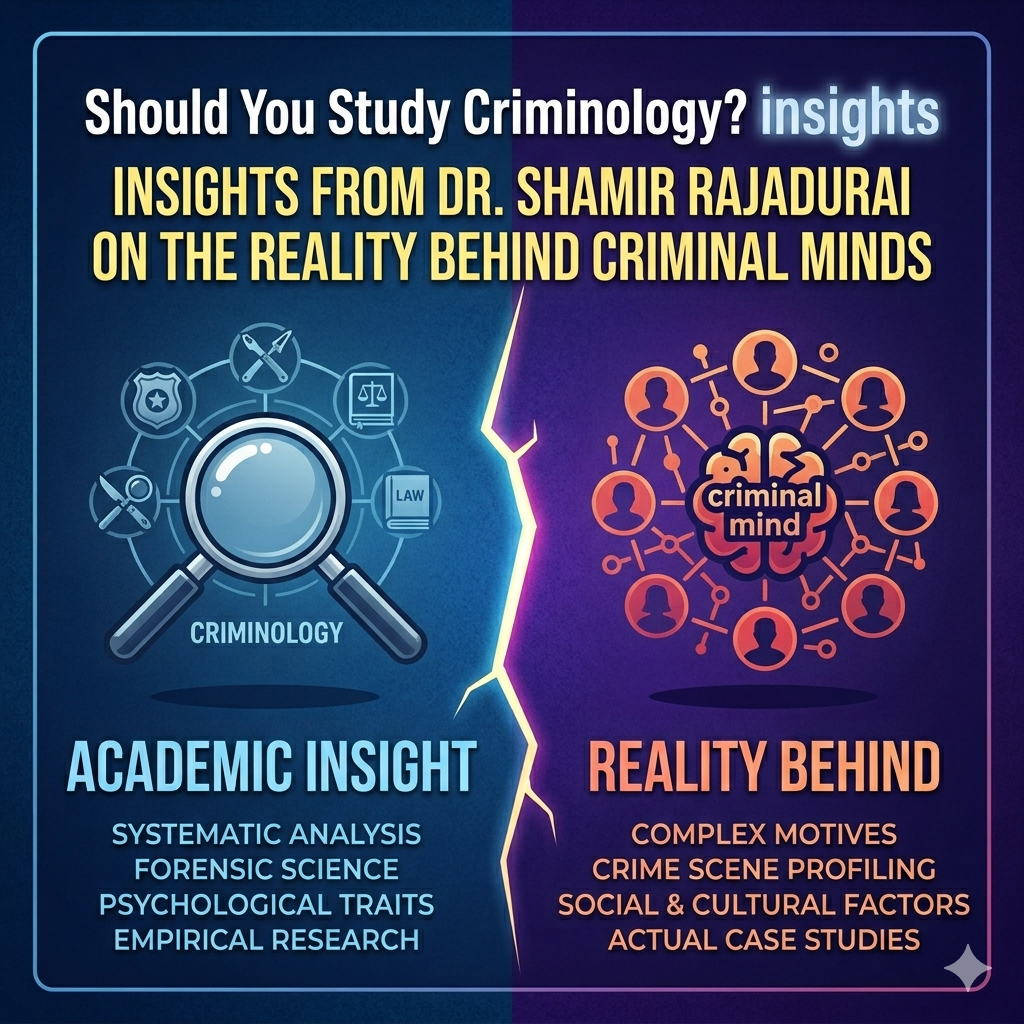
Should You Study Criminology? The Truth Behind the “Criminal Minds” Illusion
By Dr. Shamir Rajadurai, PhD
When people hear the word criminology, they often picture something straight out of television—dark interrogation rooms, psychological masterminds, and elite profilers who can “read” a criminal within minutes.
It’s an understandable misconception. Popular media has done a powerful job romanticising criminology through shows like Criminal Minds, where profiling is portrayed as the central tool for solving complex cases.
But according to Dr. Shamir Rajadurai, PhD, this version of criminology is only a small—and often exaggerated—part of a much broader and more practical discipline.
The Myth of the Criminal Profiler
Yes, criminal profiling exists. It involves studying behavior patterns, crime scenes, and psychological indicators to help infer characteristics of an unknown offender.
However, modern policing has evolved significantly.
Today, investigations are far more grounded in evidence, data, and intelligence-led approaches. The central question is no longer:
“What kind of person would do this?”
Instead, it has become:
“What does the evidence tell us happened—and where do we find more of it?”
Profiling can support investigations, but it is not the dominant tool many assume it to be.
What Criminology Is Really About
One of the biggest misunderstandings about criminology is that it is focused on catching criminals.
In reality, criminology is the study of crime itself—why it happens, how it develops, and how it can be prevented.
Dr. Shamir Rajadurai emphasizes that criminology plays a far more strategic role in modern society, including:
- Developing crime prevention frameworks such as CPTED (Crime Prevention Through Environmental Design)
- Supporting policy creation and justice reform
- Analyzing fraud, cybercrime, and insider threats
- Identifying behavioral patterns that signal risk in organizations
- Studying emerging threats such as AI-driven crime and global cyber fraud networks
Rather than focusing solely on individuals, criminology increasingly focuses on systems, environments, and behaviors.
The Shift: From Reaction to Prevention
One of the most important transformations in the field is the shift from reactive policing to proactive prevention.
Instead of only responding after crimes occur, criminologists now help design environments and systems that reduce opportunities for crime in the first place.
This includes improving organizational safeguards, strengthening cybersecurity frameworks, and understanding human behavior in high-risk environments.
In many ways, criminologists are not just analysts of crime—they are designers of safer systems.
The Real Question You Should Ask
If you are considering criminology as a field of study, Dr. Shamir Rajadurai suggests reframing the question entirely.
Instead of asking:
“Should I study criminology?”
Ask:
“Do I want to understand crime—or do I want to chase criminals?”
Because these paths, while connected, lead to very different careers and skill sets.
Criminology is less about drama and more about insight, systems, and prevention.
Final Thought
Criminology is not the cinematic world often portrayed on screen. It is less glamorous, less theatrical—but far more impactful in shaping real-world safety and policy.
Its future lies not in profiling individuals for dramatic breakthroughs, but in preventing crime before it happens by understanding behavior, systems, and opportunity.
That is where criminology truly belongs.
Work With Dr. Shamir Rajadurai
Dr. Shamir Rajadurai is a leading fraud prevention strategist specializing in criminal psychology, corporate risk, and behavioral analysis. Through real-world insights and direct engagement with offenders, he helps organizations identify risks others miss.
🌐 Website: www.preventcrimenow.com
📧 Email: shamir@preventcrimenow.com
📞 Malaysia: +6014-905 3442
Book a 15-Minute Consultation
If you’re serious about strengthening your organization’s defenses against fraud and behavioral risk:
Book a 15-minute Zoom consultation today.
Discover how understanding psychology—not just policy—can transform your approach to risk management.